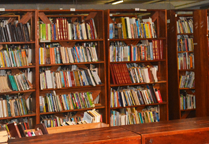
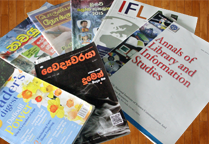
The National Library and Documentation Services Board (NLDSB) was established under the Act No: 51 of 1998 succeeding the Sri Lanka National Library Services Board (SLNLSB) which was established in 1970 under the Act No: 17 of 1970. Currently the board is placed under the Ministry of Education Services. The present Board of Directors consists of 11 members including a full time Chairman. The Director General is the chief executive of the National Library and Documentation Services Board and secretary of the Board.
The main responsibilities of the SLNLSB established in 1970, were to advise and assist in the development and modernization of library services in Sri Lanka, organizing libraries and information services at national level and to establish the National Library of Sri Lanka as the apex library in the country. Other factors which contributed for the establishment of this institute included the necessity to systematically develop the knowledge and information sector which plays a significant role in national development in the modern world and hence the necessity to give it the blessings of the government and the assistance and guidance of UNESCO.
National Library and Documentation Centre (NLDC)
The Sri Lanka National Library Services Board (SLNLSB) was established in 1970 with a prime objective of setting up the National Library of Sri Lanka. The National Library and Documentation Centre (NLDC) or the National Library of Sri Lanka (as commonly known) is functioning under the NLDSB.
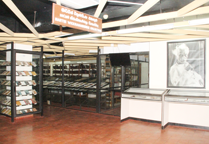
National Library of Sri Lanka serves as the leader in providing information to the nation. It’s the apex library in the library sector in the country. Being the main reference library in the country, it serves researchers, writers, publishers, academics, university students and the general public. The NLDC has been providing a wide array of services to researchers, library professionals and the general public.
Main objectives of setting up the NLDC are to ensure that documentary resources of national significance relating to Sri Lanka are collected, preserved and made accessible, to make available the National Collection (Sri Lanka Collection) for the use of all sections of the community in meeting the nation’s information needs, to make available all other publications published in, or relating to Sri Lanka or foreign publications that cater the local user needs, To receive all Sri Lankan publications under the Legal Deposit Law, to preserve the national and cultural heritage of Sri Lanka, to disseminate information in a very user-friendly manner, to promote and enhance resource sharing and co-operation among libraries and library professionals and to enhance learning and knowledge creation.
The origin of the National Library of Sri Lanka
There are many views on what constitutes a national library. Differences of opinion are mainly due to the fact that the constitution and functions of the national library are always governed by national requirements. However, there is a universal agreement supported by a UNESCO declaration that it is "the responsibility of a national library to acquire and conserve the whole of the production of published material for the benefit of present and future generations." The main notion is that the National Library should be the pre-eminent library of the nation, though a library of last resort, that it should provide consistent and able leadership to other libraries and information services in the country and that it should have organic links with other national libraries of the world. The national library does not exist in a vacuum to serve the needs of an arid sterile scholarship. Being the great repository of knowledge it must surely serve to advance the highest needs of the nation, to meet the highest aspiration of people, to assists in the process of their intellectual and spiritual development, their material progress and aesthetic fulfilment.
The origins of the National Library of Sri Lanka can be traced back to the 19th century. The establishment of the Government Oriental Library in 1870 (The first national level library, in the modern time the Ceylon), the establishment of the National Museum Library (1877) and the Printers and Publishers Ordinance (1885) can be identified as the main initiatives for the National Library of Sri Lanka. The need of a National Library for Sri Lanka was keenly felt by the government, scholars and librarians after independence. The report on the local Government Service known as the Choksy report made a clear case of this need as far back as 1955, Among other subsequent commissions that emphasised the need for a National Library where the Commission on the Colombo Public Library (Kandiah Report 1958), the special commission report on Antiquities (Brohier Report) and the Salaries and Cadres Commission (Wilmot Perera Report, 1959) as the report on School Libraries in Ceylon, by Harold V. Bonney, an UNESCO Library Expert in 1960. Since 1950, UNESCO organised a series of conferences in various parts of the world on the theme of National Planning of Library Services, with special reference to the establishment of National Libraries as apex organisations. ln December 1967, the third meeting of Experts on National Planning of Libraries in Asia was held in Colombo. A National Library Development plan for Sri Lanka was formulated at this meeting.
The plan had twin objectives: 1. To assist library authorities in organising and developing their services as internal parts of the proposed national system. 2. To set up a central library institution to be named the National Library capable of taking their leadership in the country's library services and coordinating the services of libraries belonging to all other categories. Prior to this conference, a UNESCO expert, Ms Evelyn J. Evans visited Sri Lanka in 1966 and was in Sri Lanka till 1970 as a special library adviser to the Government. She was the architect of the Library Services Board Act.